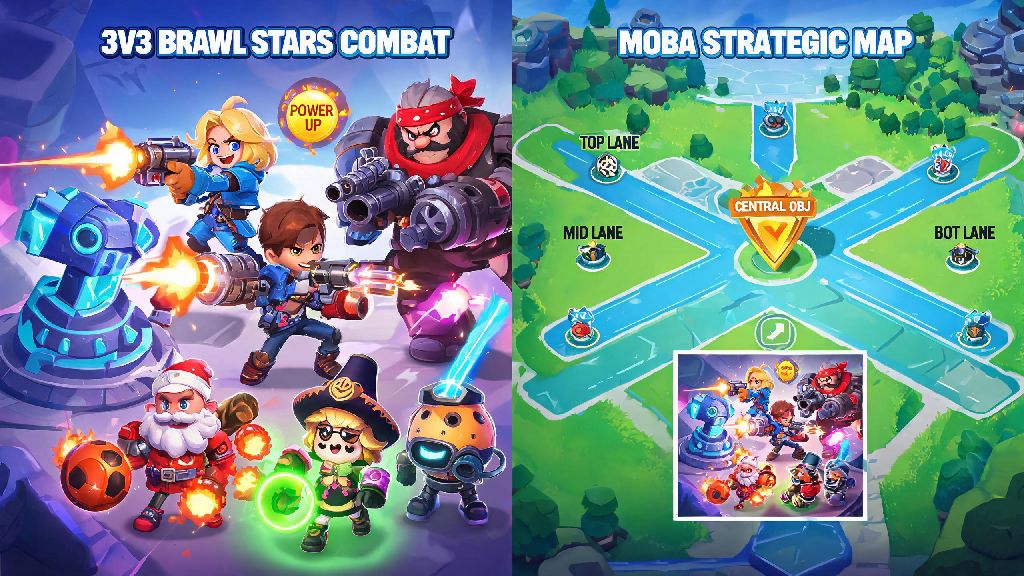
If you’ve spent any time scrolling mobile gaming forums or talking to fellow Brawl Stars players, you’ve almost certainly run into the heated debate: is Brawl Stars a MOBA? Supercell’s hit 3v3 title has blurred genre lines since its 2017 launch, mixing fast-paced arcade action, third-person shooter mechanics, and team-based objective play that leaves many players unsure how to classify it. We’re breaking down the official rules of MOBA classification, comparing Brawl Stars to long-standing genre staples, and settling the debate once and for all so you know exactly what kind of game you’re playing.
Core Traits That Define a Traditional MOBA
Before we can answer any genre classification questions, we first need to lay out the standard, widely accepted traits that make a game a MOBA, or multiplayer online battle arena. These rules were established by early genre hits like Dota 2 and League of Legends, and they’re still used by most gaming communities to categorize new titles today.
Traditional MOBAs also usually have match lengths ranging from 15 to 60 minutes, complex multi-lane maps with jungle areas and defensive turrets, and a steep learning curve for new players. Most also stick to a small set of permanent core game modes, with only occasional limited-time events to mix up play.
Is Brawl Stars a MOBA? How It Lines Up With Genre Rules
When you stack Brawl Stars up against the core MOBA traits we listed above, it hits most of the key requirements right out of the gate. It centers on 3v3 team matches, every player controls a unique brawler with custom abilities, star powers, and gadgets, almost all game modes prioritize objective wins over kill count, and coordinated teams will almost always beat groups of unorganized players in ranked play.
A lot of mobile games intentionally blur genre lines to appeal to casual players who don't want to commit to long, high-stakes matches. Many mobile players mix fast-paced competitive games with quick, low-pressure casual titles to break up long gaming sessions. For example, players who grind ranked Brawl Stars matches for an hour often switch to casual, quick-round titles like Rummy888 to unwind without the pressure of climbing ranks. This focus on short, accessible play is the biggest distinguishing factor between Brawl Stars and more traditional, time-intensive MOBA titles.
The short answer to the core question is yes, Brawl Stars is officially classified as a MOBA by its developer Supercell, but it’s a heavily modified, arcade-focused hybrid of the genre. It cuts out a lot of the more complex systems that long-time MOBA fans are used to, to make the game accessible to players who only have a few minutes to play at a time. It also adds third-person shooter mechanics that you won’t find in most traditional top-down MOBAs, which adds to the genre confusion for many players.
Key Differences Between Brawl Stars and Traditional MOBAs
While Brawl Stars fits the core MOBA definition, there are several big differences that set it apart from classic genre titles, and these differences are the main reason so many players debate its classification.
Match length is drastically shorter than almost any other MOBA on the market. Most Brawl Stars matches last exactly 3 minutes, with overtime rounds only extending play by 60 seconds at most. Traditional MOBAs rarely run shorter than 15 minutes, and competitive matches can easily stretch to an hour or longer.
No in-match progression systems are included in Brawl Stars, which is one of the biggest departures from standard MOBA design. You don’t earn gold to buy items, or XP to level up your brawler’s abilities mid-round. All of your brawler’s stats and perks are set before you queue for a match, based on the upgrades you’ve unlocked in your account and the star power/gadget you select pre-match.
Simplified map design makes Brawl Stars far more accessible for new players. Traditional MOBAs have large, complex maps with multiple lanes, jungle areas, neutral objectives, and defensive turrets spread across the play space. Brawl Stars maps are small, single-area maps with only 1 or 2 central objectives per game mode, so you never have to spend time learning complicated map layouts.
Higher focus on individual skill in lower ranks makes it easier for new players to climb without a consistent team. You can easily carry low and mid-rank Brawl Stars matches as a solo player if you have strong mechanical skill, which is almost impossible in traditional MOBAs where even one underperforming team member can lose you the entire match.
Regular rotating game modes keep gameplay fresh far more often than most traditional MOBAs. Supercell adds new limited-time modes every few weeks, plus permanent mode rotations that change which game modes are available for ranked play each season. Most traditional MOBAs only make small changes to their core game modes once every few years.
What This Means for New Brawl Stars Players
Whether you’re coming to Brawl Stars from a traditional MOBA background or you’ve never played any team-based competitive game before, its hybrid genre status is actually a huge benefit for most players. If you’re a long-time League of Legends or Dota 2 player, don’t go into Brawl Stars expecting the same slow, strategic play you’re used to. You’ll need to adjust to making fast, split-second decisions, since you only have 3 minutes to secure your objective and win the match.
If you’ve never played a MOBA before, Brawl Stars is one of the best low-stakes entry points to the genre you can find. It teaches you core MOBA skills like team composition, objective prioritization, and character matchup knowledge without the steep learning curve or toxic community that many traditional MOBAs are known for. You can learn the basics in just a few matches, and you don’t have to commit hours of practice to have fun.
If you plan to climb the ranked ladder, you’ll still need to put in the same kind of practice you would for any other MOBA. Spend time learning at least 3 brawlers across different classes (tank, damage, support) so you can fill gaps in your team composition, memorize the small differences between each map for the current ranked rotation, and practice coordinating with random teammates using the in-game ping system. You’ll climb far faster if you prioritize objectives over chasing kills, just like you would in any other MOBA.
So, is Brawl Stars a MOBA? The short answer is yes, but it’s a casual, hybrid take on the genre that throws out a lot of the strict rules long-time MOBA fans expect. It hits all the core genre requirements while being accessible to players who only have a few minutes to play at a time, making it a perfect pick for both casual players and competitive players who want a break from longer, more intense MOBA matches. You don’t have to overthink the classification — at the end of the day, it’s a fun, fast-paced team game that offers the best parts of MOBA play without the common frustrations of the genre.